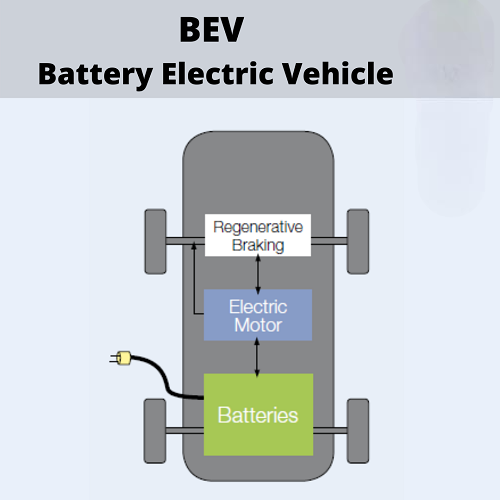
Battery Electric Vehicles (BEVs), also known as all-electric vehicles, are powered exclusively by electricity stored in a rechargeable battery pack. They do not have an internal combustion engine (ICE) or use any form of fossil fuel. Instead, they rely entirely on an electric motor to drive the wheels.
Key Components of BEVs
- Battery Pack
- Stores electrical energy required to power the vehicle.
- Typically made of lithium-ion batteries, offering high energy density and long life.
- The size of the battery determines the vehicle’s range.
- Electric Motor
- Converts electrical energy from the battery into mechanical energy to drive the wheels.
- Operates silently and delivers instant torque for quick acceleration.
- Inverter
- Converts direct current (DC) from the battery into alternating current (AC) for the electric motor.
- Plays a key role in controlling motor speed and power output.
- Charging Port
- Allows the battery to be charged from an external power source, such as a home charger or public charging station.
- Onboard Charger
- Converts incoming AC electricity into DC electricity to charge the battery.
- Regenerative Braking System
- Captures energy lost during braking and stores it back in the battery, improving efficiency.
- Power Electronics Controller
- Manages the flow of electricity between the battery and motor, controlling speed, torque, and energy use.
- Thermal Management System
- Regulates the temperature of the battery and motor to ensure optimal performance and longevity.
How BEVs Operate
- Starting the Vehicle
- The driver powers on the vehicle, activating the battery and motor systems.
- Energy Flow to the Motor
- The battery sends electrical energy to the inverter, which converts it into a usable form for the motor.
- The motor drives the wheels, propelling the vehicle forward.
- Acceleration
- BEVs deliver instant torque, meaning the electric motor provides full power as soon as the accelerator is pressed.
- This results in smooth and rapid acceleration.
- Driving
- Energy consumption varies based on speed, terrain, and driving behavior.
- Regenerative Braking
- When the driver brakes or decelerates, the motor acts as a generator, converting kinetic energy back into electrical energy to recharge the battery.
- Charging the Battery
- When the battery depletes, the vehicle must be plugged into a charging station or wall outlet to replenish energy.
- Charging times depend on the charger type:
- Level 1: Standard household outlet, slow charging.
- Level 2: Dedicated home or public charger, faster charging.
- DC Fast Charger: Rapid charging for quick energy replenishment.
Advantages of BEVs
- Zero Emissions: BEVs produce no tailpipe emissions, making them environmentally friendly.
- Lower Operating Costs: Electricity is typically cheaper than gasoline, and BEVs have fewer moving parts, reducing maintenance costs.
- Smooth Performance: Electric motors provide quiet, vibration-free operation and instant torque.
Challenges of BEVs
- Range Anxiety: Limited driving range compared to traditional vehicles, though improving with newer models.
- Charging Infrastructure: Access to charging stations can be a concern in some regions.
- Battery Costs: Batteries are expensive to manufacture, though prices are decreasing over time.