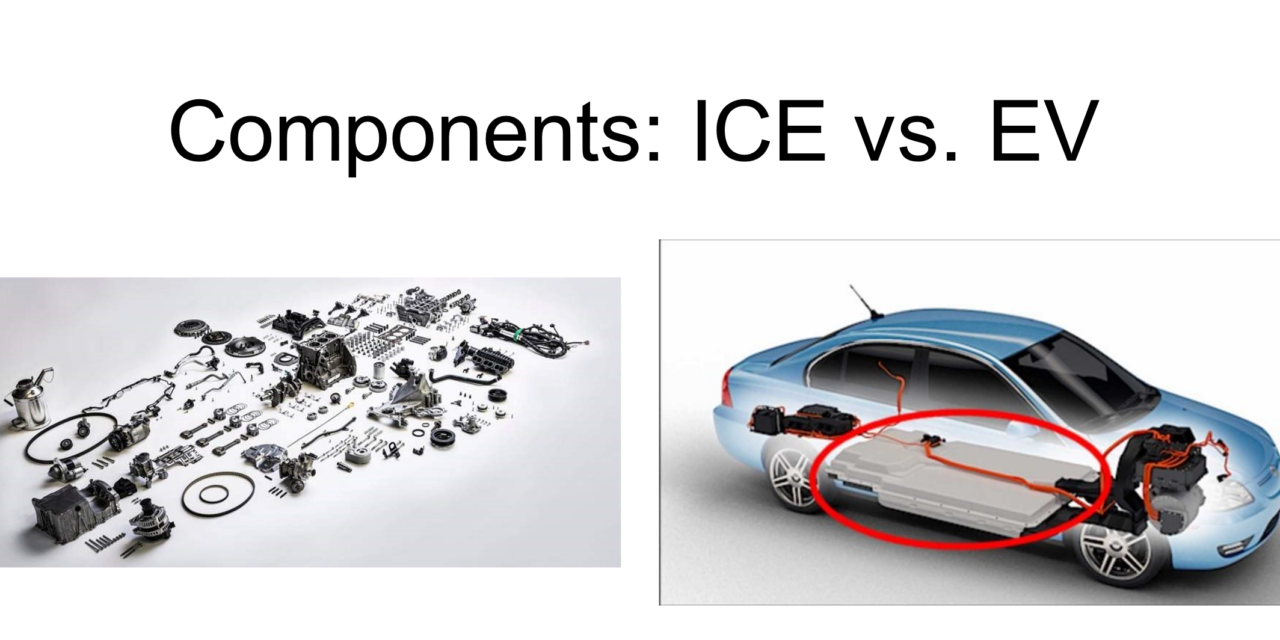
The powertrain components of electric vehicles (EVs) differ significantly from those found in internal combustion engine (ICE) vehicles due to the fundamental differences in how the two types of vehicles generate and use power. Below is a comparison of the key powertrain components in EVs and ICE vehicles:
1. Engine vs. Motor
- Internal Combustion Engine (ICE):
- Type: ICE vehicles use a combustion engine that burns fuel (usually gasoline or diesel) to generate power. The engine involves many moving parts, including pistons, crankshafts, and valves, which convert chemical energy into mechanical energy.
- Fuel Type: Uses liquid fuel (gasoline, diesel) stored in the fuel tank.
- Operation: The engine generates power through the combustion process, where fuel is mixed with air and ignited by spark plugs or compression.
- Electric Vehicle (EV):
- Type: EVs use an electric motor that operates based on electromagnetism. The motor is simpler, with fewer moving parts compared to an ICE.
- Energy Source: The motor is powered by electricity stored in batteries, typically lithium-ion batteries.
- Operation: The motor produces torque directly, which is used to drive the wheels. It operates quietly and with greater efficiency than an internal combustion engine.
2. Fuel System vs. Battery System
- Internal Combustion Engine (ICE):
- Fuel System: ICE vehicles have a fuel tank that stores liquid fuel (gasoline or diesel). This fuel is pumped through a system of fuel lines to the engine where it is mixed with air and ignited.
- Fuel Delivery: The fuel is delivered by a fuel pump, regulated by an electronic control unit (ECU), and is managed by a system of injectors and valves.
- Electric Vehicle (EV):
- Battery System: EVs are powered by large battery packs, typically lithium-ion or other advanced chemistries. These batteries store electrical energy and provide it to the electric motor when needed.
- Battery Charging: Instead of refueling at a gas station, EVs are recharged by plugging into an electrical outlet or specialized charging stations.
- Energy Storage: The battery stores energy in a DC (direct current) form, which is then converted to AC (alternating current) for the motor in the case of most EVs, or used directly in the case of others (e.g., some Tesla models).
3. Transmission vs. Single-Speed Gearbox
- Internal Combustion Engine (ICE):
- Transmission: ICE vehicles typically use a multi-speed transmission (manual or automatic) to transfer power from the engine to the wheels. The transmission system adjusts the engine’s torque and speed by changing the gear ratio.
- Clutch: Manual transmissions require a clutch to disconnect the engine from the drivetrain temporarily to change gears. Automatic transmissions use a torque converter or dual-clutch system to automate gear shifts.
- Electric Vehicle (EV):
- Transmission: Most EVs use a single-speed transmission (or fixed-gear transmission), as electric motors provide a broad torque range and can operate efficiently at different speeds without needing gear shifts.
- No Clutch: Since EVs do not need to change gears, there is no clutch or complex transmission system. This makes the EV drivetrain simpler and more efficient.
4. Exhaust System vs. Regenerative Braking
- Internal Combustion Engine (ICE):
- Exhaust System: ICE vehicles have an exhaust system that includes components like the exhaust manifold, catalytic converter, and muffler to direct exhaust gases away from the engine, reduce harmful emissions, and control noise. These systems are necessary because combustion engines emit CO2, NOx, and other pollutants.
- Electric Vehicle (EV):
- Regenerative Braking: EVs do not produce exhaust gases, so they lack an exhaust system. Instead, they often use regenerative braking, which converts kinetic energy from the vehicle’s motion back into electrical energy, storing it in the battery. This process helps extend the vehicle’s range and reduces wear on brake pads.
5. Cooling System
- Internal Combustion Engine (ICE):
- Cooling System: ICE vehicles have a radiator and cooling system that circulates coolant (usually a mixture of water and antifreeze) to dissipate heat from the engine and prevent overheating. The engine produces a large amount of heat during combustion, and the cooling system ensures that the engine operates within a safe temperature range.
- Electric Vehicle (EV):
- Cooling System: EVs still require a cooling system, but it’s typically used to cool the battery pack and electric motor, both of which can generate heat during operation. EV cooling systems are more focused on maintaining battery performance and longevity, as well as cooling the motor.
6. Fuel Efficiency and Emissions
- Internal Combustion Engine (ICE):
- Fuel Efficiency: ICE vehicles are less efficient than EVs in terms of energy conversion. The energy from gasoline or diesel is not fully utilized, and much of it is lost as heat during combustion.
- Emissions: ICE vehicles emit CO2, NOx, and particulate matter, contributing to air pollution and global warming.
- Electric Vehicle (EV):
- Fuel Efficiency: EVs are much more energy-efficient, with electric motors typically having an efficiency of around 85-90%, compared to the 20-30% efficiency of ICE engines.
- Emissions: EVs produce no direct emissions, making them zero-emissions at the tailpipe. However, their overall environmental impact depends on how the electricity used to charge them is generated (e.g., coal vs. renewable energy sources).
7. Complexity and Maintenance
- Internal Combustion Engine (ICE):
- Complexity: ICE vehicles have many complex moving parts, including pistons, valves, and a multi-speed transmission system, all of which require regular maintenance and repairs.
- Maintenance: ICE vehicles require frequent oil changes, fuel filter replacements, exhaust system maintenance, and regular inspections of the transmission and engine components.
- Electric Vehicle (EV):
- Simplicity: EVs have far fewer moving parts than ICE vehicles, mainly consisting of the electric motor, battery pack, and inverter. There are no exhaust systems, fuel tanks, or multi-speed gearboxes.
- Maintenance: EVs require less maintenance overall, as they don’t need oil changes, fuel filter replacements, or exhaust system repairs. Maintenance is mainly focused on the battery and motor system, although the brake system also tends to last longer due to regenerative braking.
8. Noise and Vibration
- Internal Combustion Engine (ICE):
- Noise and Vibration: ICE vehicles produce significant noise and vibration due to the combustion process and the movement of internal engine components.
- Electric Vehicle (EV):
- Noise and Vibration: EVs are generally much quieter because electric motors produce minimal noise and vibration. This contributes to a smoother and more comfortable driving experience.
Conclusion
The key difference between the powertrain components of electric vehicles (EVs) and internal combustion engine (ICE) vehicles is that EVs use a much simpler and more efficient electric motor powered by batteries, while ICE vehicles rely on complex combustion engines, fuel systems, and multi-speed transmissions. EVs are more energy-efficient, environmentally friendly, and require less maintenance compared to ICE vehicles, but they also depend on advanced battery technology for energy storage and range.
Hashtags
#EVPowertrain #ElectricPowertrain #ElectricVehicleComponents #EVBatteryPack #ElectricMotor #EVController #InverterTechnology #EVChargingSystem #RegenerativeBraking #EVPowerConverter #EVDriveUnit #ElectricAxle #BatteryManagementSystem #ICEPowertrain #InternalCombustionEngine #ICEComponents #GasolineEngine #DieselEngine #FuelTank #FuelInjector #ExhaustSystem #TransmissionSystem #Turbocharger #StarterMotor #ClutchSystem
#TimingBelt #EVvsICE #ElectricMotorVsGasEngine #EVBatteryVsFuelTank #ElectricMotorEfficiency #ICEFuelEfficiency #ZeroEmissionsEV #LowEmissionsICE