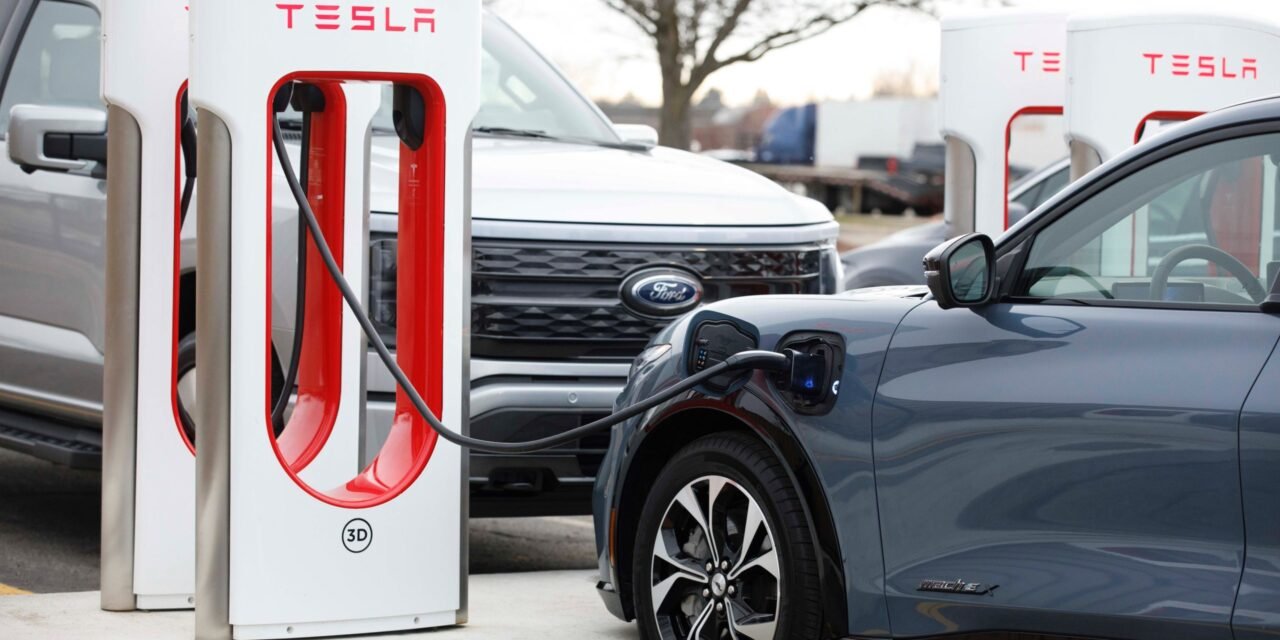
Tesla’s North American Charging Standard (NACS) is rapidly becoming the dominant charging standard across the electric vehicle (EV) industry, as an increasing number of automakers adopt it for their future EVs. This development marks a pivotal shift in the EV infrastructure landscape, as Tesla’s charging solution is seen as both efficient and scalable, offering significant advantages for drivers and manufacturers alike. Automakers including Ford, General Motors (GM), Rivian, and others have announced their plans to integrate Tesla’s NACS port into their upcoming EVs, further solidifying its position as the industry’s preferred charging option.
By adopting Tesla’s NACS, these companies are aligning with a proven and well-established charging infrastructure. Tesla’s Supercharger network, one of the largest and most reliable in North America, has long been a competitive edge for the company. For consumers, this means increased access to a fast, unified charging solution that eliminates the need for multiple adapters or different charging networks. For automakers, it reduces the logistical complexities and costs associated with maintaining their own proprietary charging networks, while allowing them to tap into Tesla’s extensive and growing network of Superchargers.
The move to embrace Tesla’s NACS also comes in response to the industry’s need for greater interoperability and a more streamlined charging experience. Previously, the EV market was fragmented, with different manufacturers using incompatible charging standards like CCS (Combined Charging System) or CHAdeMO. The unification under NACS provides consumers with a seamless charging experience, reducing range anxiety and making it easier to travel long distances without worrying about finding the right type of charger.
Tesla’s decision to open up its charging infrastructure to other automakers is also a strategic business move for the company. By expanding access to its Supercharger network, Tesla increases the utilization of its chargers and positions itself as a key player in the broader EV ecosystem, not only through vehicle production but also by providing essential infrastructure for other automakers’ customers. Additionally, it further strengthens Tesla’s competitive advantage as a global leader in electric mobility.
Overall, the widespread adoption of Tesla’s North American Charging Standard signals a major milestone in the evolution of the electric vehicle market. By promoting a unified and reliable charging standard, Tesla is helping to accelerate the transition to electric vehicles, while simplifying the charging process for consumers and automakers alike. This movement sets the stage for a more integrated and efficient EV ecosystem across North America, ultimately benefiting the entire electric vehicle industry and boosting consumer confidence in electric mobility.